Your AI dev team.
On any model, any machine.
agent-team plans a roadmap, builds features as pull requests, reviews them, fixes what reviewers ask for, merges and releases, through GitHub, like a small team would. The rules that keep it safe are enforced in code, not left to the models.
pipx install agent-team
From idea to market
Conceive. Create. Commercialise.
Take a product from an idea to the people who use it, with a team that never sleeps and never skips a review.
Agree what to build
The members discuss and agree a roadmap, weigh what developers ask for, and turn it into GitHub issues.
Build it properly
Plans, tests first, code, reviews with tools, security checks and fixes, a pull request at a time.
Ship it and tell the world
Merges and releases with your approval, and a positioning brief, website and pitch deck checked against the code.
The team
Members with jobs, not one chatbot.
Each member has a role, a model and the files it owns. Name them, add more, put each on the model that suits the job: Claude where judgement matters, a local model where volume does.
Atlas
Plans the work, reviews every change against the plan and the project's guarantees.
claude-opus-5-5Forge
Writes the code with small search/replace edits, round after round, until the lead approves.
qwen on your MacHarbor
Runs shifts on GitHub: triage, sign-offs, fixes, merges, releases, a feedback digest.
claude-sonnet-5-5Spark
Writes the brief, the website and the pitch deck, checked against the code and reviewed with screenshots.
claude-sonnet-5-5Sentinel
Reviews every approved build and signs off every pull request.
Probe
Writes the tests for a plan before anyone builds it.
Quill
Brings the README, docs and changelog up to date after every build.
Yours
Any role with its own prompt and skills, on any model, on any machine.
How it works
From roadmap to release, a pull request at a time.
Run each step yourself, or let autopilot work through a milestone: it builds the next issue, and each devops shift reviews, fixes and merges, until the lead says the milestone is done.
Guardrails
Rules in code, not in prompts.
Models are asked nicely; the tools they act through check. A shift can't merge what the rules don't allow, whatever the model says.
Approvals tied to a commit
Green CI, the lead's approval and every owner's sign-off, all on the exact head commit. A new commit needs them again.
You decide what matters
Paths like auth/ or dependency files wait for your approval, and releases can too.
Sandboxed tests
The code the team writes runs in a throwaway container, with no network and none of your keys.
No secrets pushed
Every push is scanned for keys, tokens and private keys first. Keys stay in your environment.
Spend limits
Per run, per day and per milestone, checked before every model call, with an estimate before you start.
Outside text is data
Issues, PR text and comments reach the models marked untrusted, never as instructions.
Any model, any machine
Mix Claude, local models and your own hardware.
A team runs entirely on Ollama with no API key, entirely on Claude, or anything in between. A weaker model hands its work to a stronger one after a rejected round.
Claude
Opus to lead and review, Sonnet to build and ship, Haiku for routine checks.
Local models
Ollama on this machine or another: Qwen, Llama and friends, at no per-token cost.
Any compatible server
vLLM, LM Studio, llama.cpp or a hosted gateway.
Your other machines
A GPU box runs agent-team serve; the team finds it on the network.
The dashboard
See everything. Change anything. Approve with a click.
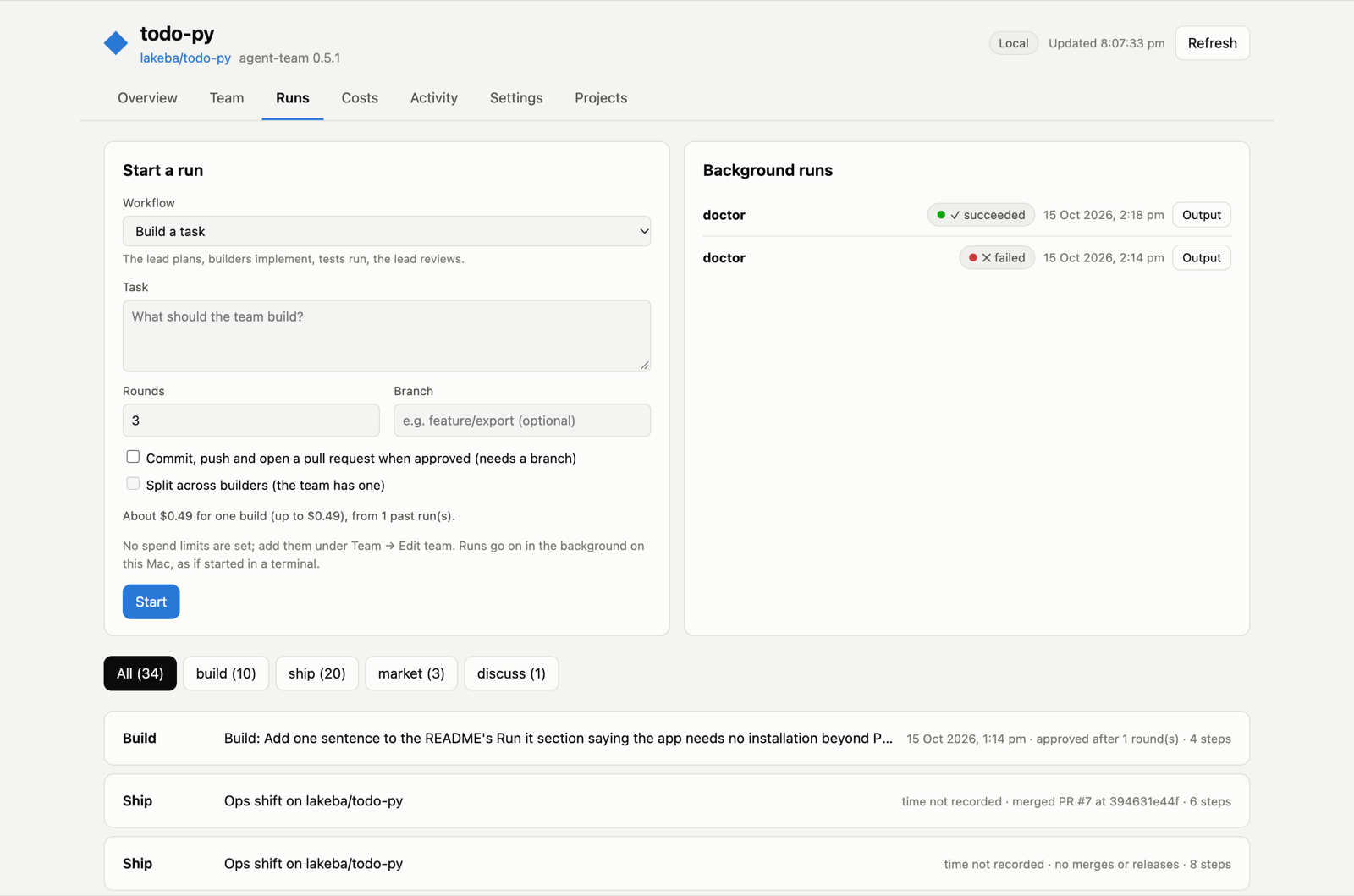
agent-team ui runs on your machine: the team and its health, every run with each
member's verdicts, costs and the scoreboard, live activity, easy settings and templates, and every project you have.
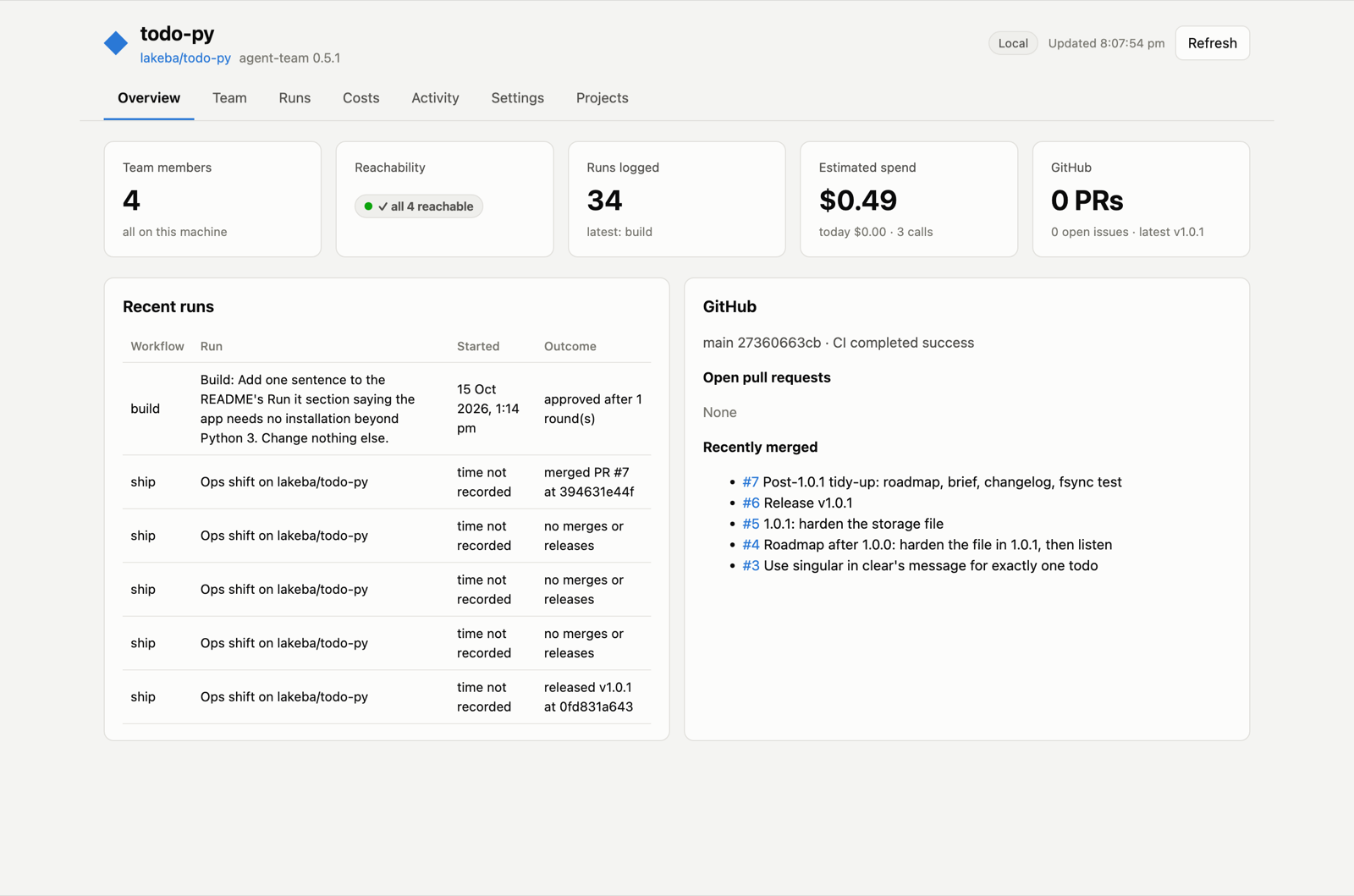
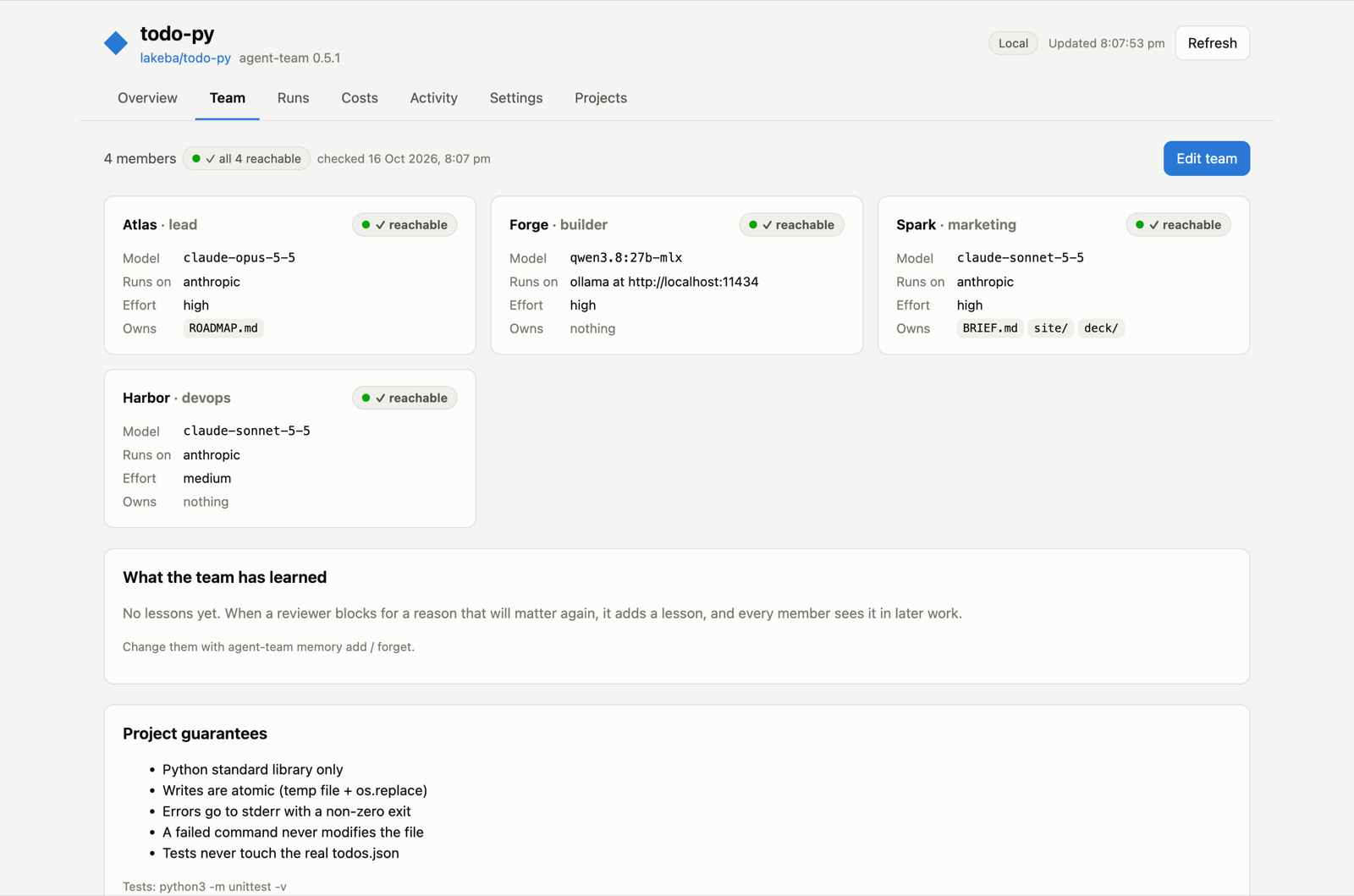
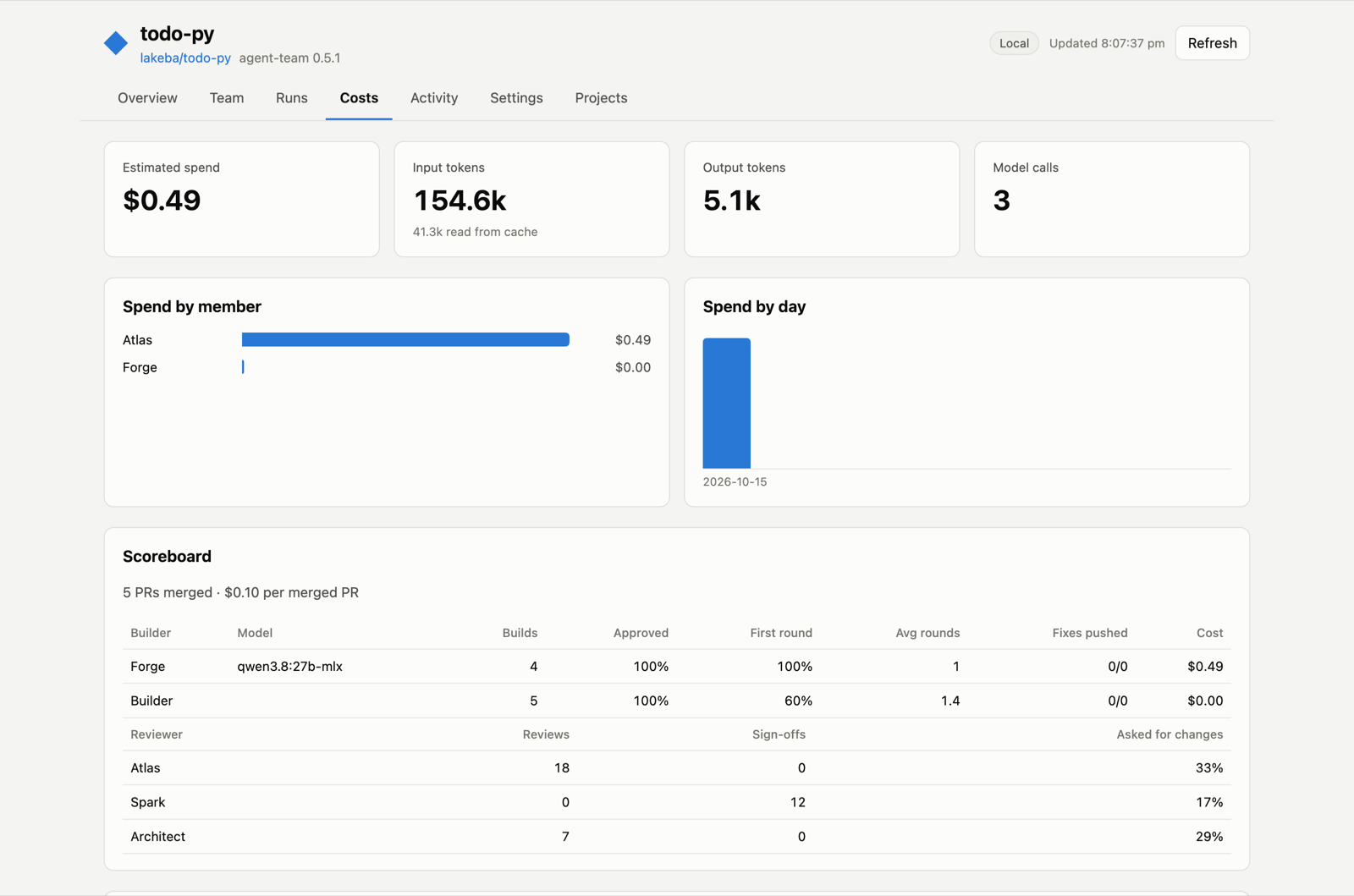
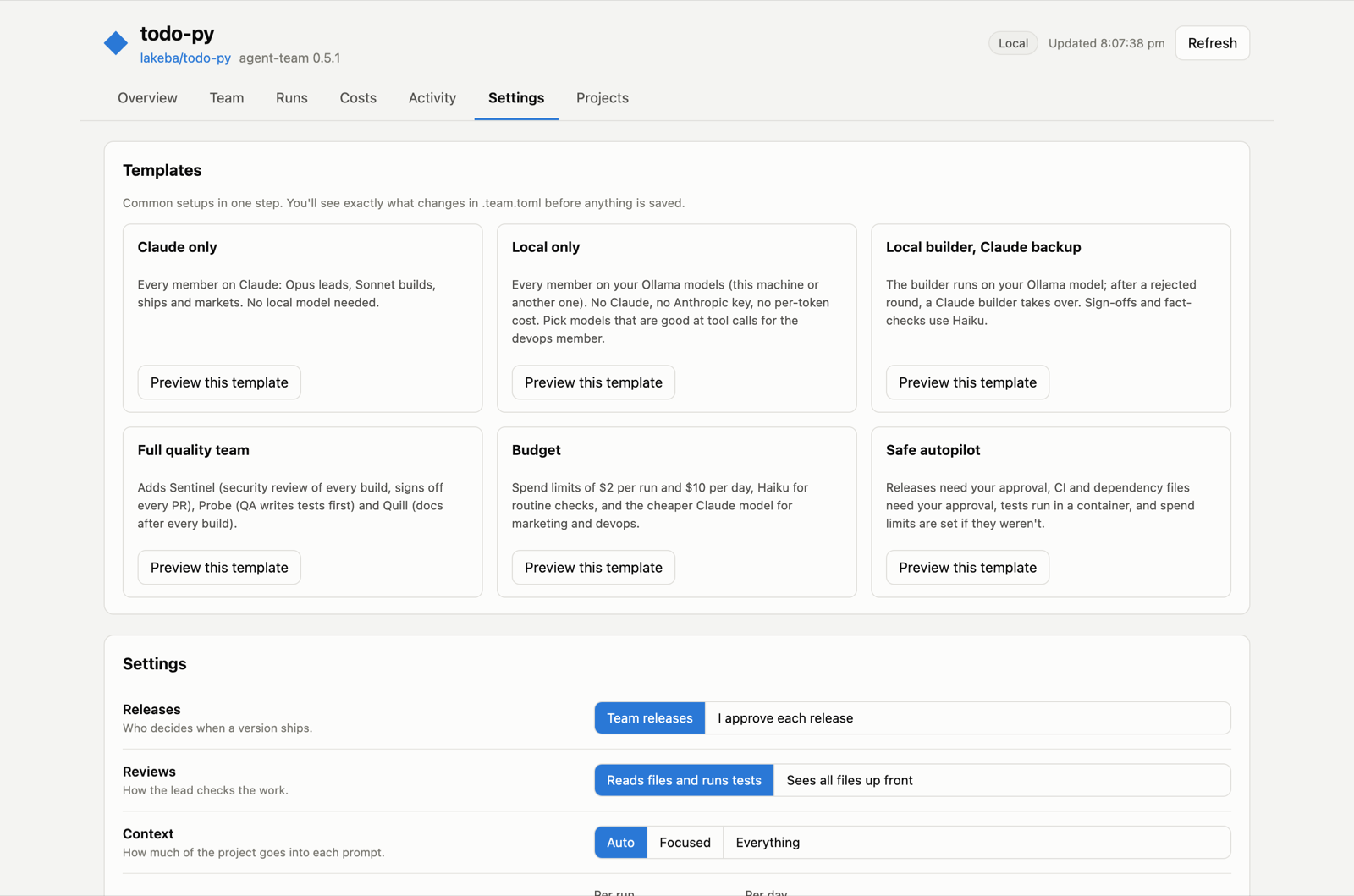
Overview: the team's health, recent runs, spend and GitHub at a glance.
Claude Code
Drive the team from Claude Code.
The plugin adds slash commands and a side panel with the team, its health, recent runs, spend and anything waiting for your approval. Claude runs the workflow where you can watch, checks the result, and reports.
/team-initset up a team/team-planagree a roadmap/team-buildbuild a task as a PR/team-shipone devops shift/team-fixapply a review to a PR/team-autopilotwork through a milestone/team-issuesthe to-do list on GitHub/team-scheduleshifts on a timer/team-panelthe side panelGet started
Three commands to a working team.
macOS or Linux with Python 3.11+ and git. GitHub's CLI for the pull-request workflows. An Anthropic key only if members use Claude.
Install
The CLI, and the Claude Code plugin if you use it.
or the one-line installer from the README
Set up a project
A checklist of what's missing, then a team file you can edit.
Put it to work
Plan, build, or open the dashboard.

Shared by Lakeba
CONCEIVE · CREATE · COMMERCIALISE
agent-team is an open-source project that Lakeba shares with its partners, its clients and the whole community of software developers. It's free under the MIT licence: use it, change it, and tell us what you'd like it to do next.
Give your repository a team.
Open source, runs on your machine, works with the models you already have.